

If you search tree removal crane rental online, you may find a crane advertised for a few hundred dollars an hour and then receive a tree-removal estimate for several thousand dollars.
Those numbers look miles apart because they are usually pricing two different things.
A crane rental can give you the machine and, depending on the agreement, an operator. It does not automatically give you the tree crew that plans the removal, rigs each section, makes the cuts, handles the landing zone, chips the branches, moves the logs, hauls the debris, and cleans the property.
When we quote a crane-assisted removal at Arbor Tree Service, we are looking at the tree-removal operation as a whole.
That is the difference homeowners need to understand before comparing a rental rate with a full-service quote.
The crane is only one part of crane-assisted tree removal

The crane gets most of the attention because it is the largest machine on the job. It still cannot remove the tree by itself.
On a typical crane job, we first have to understand the tree, its condition, the structures around it, where the crane can stand, how far the boom has to reach, and where each lifted section can be landed and processed.
Then the actual tree work starts.
The section being removed has to be rigged. The crane has to take the intended load. The cut has to be made in a way that works with the pick. The operator and tree crew have to communicate through the lift. Once the piece reaches the landing area, the crew still has to process it.
That process repeats until the tree is down.
The crane is a major tool in the removal. It is not the removal crew.
What does it cost to rent a crane for tree removal?
Published 2026 industry guides show broad national crane-rental figures around:
- roughly $150 per hour for some mid-size crane-and-operator arrangements, often with a minimum number of hours;
- around $500 to $1,500 per day for some smaller crane classes;
- approximately $1,500 to $3,000 for larger mid-range equipment;
- $3,000 to $5,000 or more per day for larger cranes.
Those are outside market references, not Arbor Tree Service prices.
They also vary by crane, location, working radius, rental company, minimum hours, travel, setup, demand, and the exact contract.
A Massachusetts crane job should never be budgeted by finding the lowest national hourly rate and multiplying it by the number of hours you think the tree will take.
First, the crane company may have a minimum charge. Second, mobilization and travel may be separate. Third, the crane size you need cannot be determined from tree height alone.
And the biggest issue remains: that rental figure may cover only one piece of the actual removal.
What a crane rental may not include
This is where homeowners can make an expensive comparison mistake.
Suppose you find a crane advertised with an operator. Before treating that as your tree-removal cost, ask what the contract actually includes.
- Does it include someone qualified to rig the tree?
- Who makes the cuts?
- Who estimates the weight and balance of each tree section?
- Who supplies the tree rigging?
- Who manages the exclusion zone on the ground?
- Who handles branches after the crane lowers them?
- Who cuts and loads the trunk wood?
- Who brings the chipper?
- Who hauls the debris?
- Who cleans the property?
- If the crane occupies the street, who handles the local requirements and traffic plan?
Those are not minor details added after the “real” job.
They are the job.
A crane operator and a tree crew have different responsibilities
Crane operation requires its own training and licensing. Tree removal requires another set of skills.
The operator works with the crane, its configuration, capacity, load chart, boom position, and movement of the load.
The tree crew has to understand the tree itself: where the section can be attached, how the wood is likely to move after the cut, what is holding the section before separation, where people can stand, and how the piece will be processed after the lift.
On our crane service for tree removal jobs, we plan those roles together rather than treating the crane and tree crew as two unrelated appointments.
That coordination is part of what you are paying for in a complete crane tree removal.
Massachusetts also regulates crane operation
There is another reason homeowners should not think of an industrial crane like a piece of equipment they casually rent for the weekend.
Massachusetts regulates covered hoisting machinery and the people who operate it.
A homeowner does not save money by trying to replace qualified crane operation with DIY equipment use.
Even when a crane arrives with its operator, you still need to know who is responsible for the arboricultural side of the job.
The machine being legally and properly operated does not automatically mean the tree removal around it has been planned.
What does a full crane tree service cost?
National cost guides currently publish very broad figures for crane assisted tree removal, often somewhere between $2,000 and $15,000 or more.
Some put many residential crane jobs in roughly the $3,500 to $8,000 range.
We would not use those numbers to quote your tree.
A $3,500 tree in one market can easily be a very different project from another tree with the same height.
Here in eastern Massachusetts, we want to see the site before giving you a number. Our written estimate is based on what your removal actually requires.
Why two 70-foot trees can have completely different prices
Height helps us understand a tree, but height does not tell us the entire job.
Imagine two mature trees that are both around 70 feet tall.
The first stands in an open front yard. The crane can set up close to it. There is room for outriggers. The landing area is nearby. The wood can be processed right beside the work zone.
The second tree stands behind a house in a dense neighborhood. The crane has to set up in the street and reach over the roof. The boom works at a longer radius. There may be wires, parked vehicles, neighboring property, fences, or limited space for processing wood.
Same tree height. Very different crane problem.
That is why we do not price crane work by height alone.
Reach can matter as much as tree size
One of the easiest things to miss when estimating crane work is working radius.
A crane does not have the same lifting capacity at every boom position.
As the load moves farther away from the crane, the available capacity changes according to the machine’s load chart.
That means a heavy section 20 feet from the crane is not the same lift as an identical section 80 feet away.
A backyard tree may require a larger crane than the homeowner expects, even when the tree itself is not unusually tall.
We look at where the crane can actually stand before deciding what equipment the job needs.
Access changes the price before the first cut
When we inspect a crane job, we are looking at more than the tree.
- Can the crane reach the property?
- Is the street wide enough?
- Can the equipment safely enter the driveway?
- Where can the outriggers be set?
- What is underneath that area?
- Are there overhead lines?
- Does the boom have a clear path?
- Where will the lifted sections land?
- Can trucks and chippers work near that landing area?
- Will we need to move material farther before it can be processed?
Each answer changes the amount of equipment, labor, and time involved.
Newton is a good example of why access matters
Our tree removal work in Newton, MA often involves mature trees on developed lots where homes, fences, sidewalks, streets, and neighboring property leave little room for conventional dropping.
That is exactly the kind of setting where looking only at a crane rental day rate tells you very little.
The crane may need to sit farther from the tree. Sections may need to travel over a house. The work zone may extend into or near the public way. The tree may need to be dismantled in smaller picks because of the working radius.
A homeowner sees one tree.
We have to plan the path of every major piece from the canopy to the processing area.
Somerville adds another layer to the planning
Our tree removal service in Somerville, MA starts with the tree, surrounding obstacles, access, and the removal method because dense properties leave little margin for improvising once the work begins.
Somerville also has its own tree-removal and public-way requirements.
If equipment needs to occupy the street, municipal requirements can become part of the schedule and cost.
That is another reason a national “crane costs X dollars per hour” number cannot tell you what a Somerville crane removal will cost.
The machine rate is only one line in a local job.
When hiring the crane separately can make sense
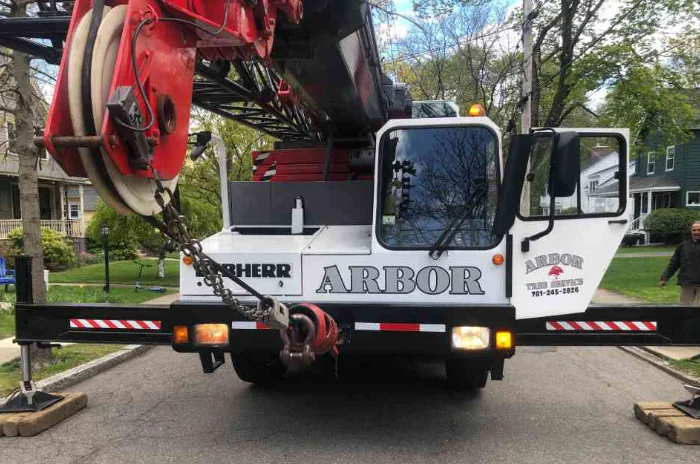
Independent crane rental is not inherently a bad idea.
Tree companies do it.
A professional tree contractor may already have the climber, rigging equipment, ground crew, chipper, trucks, insurance, work-zone plan, and job supervision. In that case, bringing in a crane and operator for the lift portion can be a normal way to build the job.
The tree company is still managing the tree operation.
That is very different from a homeowner hiring a crane first and then trying to assemble everyone else around the reservation.
If you already have a qualified tree contractor who specifically wants you to arrange the crane, clarify responsibilities in writing before doing it.
For most homeowners, however, there is little advantage in becoming the coordinator between the crane company and the tree company.
The schedules have to match
Crane time costs money. So does a tree crew waiting for a crane.
If the crane arrives before the tree crew is ready, part of the paid rental window can disappear before the first pick.
If the tree crew arrives and the crane is delayed, you may have labor sitting on the property.
If site access was misunderstood and the crane cannot set up where expected, the equipment you rented may not work for the planned picks.
A turnkey crane removal puts those scheduling decisions inside the same work plan.
We inspect first, determine the setup, and build the job around the removal rather than asking the tree to fit an equipment reservation that was made earlier.
Minimum rental time matters
A crane advertised at an attractive hourly number may still have a four-hour, half-day, or full-day minimum.
If your actual crane work takes two hours, you may still pay the contractual minimum.
If the job runs beyond the included block, another hourly rate may apply.
This is why we would not tell a homeowner, “Your crane portion should take three hours, so multiply three by the advertised rate.”
Rental pricing rarely works that cleanly.
You need the actual quote for the machine that can perform the planned lift at the required radius.
Mobilization can be part of the bill
The crane has to get to your property.
Depending on the provider and distance, travel or mobilization may appear as its own charge or may already be built into the minimum.
Published cost guides sometimes quote several hundred dollars for mobilization.
Again, that is a market reference rather than a Massachusetts price we would apply to every job.
When you compare estimates, the better question is whether mobilization is already included.
Otherwise, you can end up comparing one quote with delivery built in against another that adds it later.
Permits are not a flat national fee
Online cost guides often publish ranges for crane or street permits.
We prefer to check the municipality.
A crane sitting fully on private property may create a different permit situation from one occupying a lane of a public street.
Somerville, for example, requires a street occupancy permit for construction equipment staged in the public way. Tree-removal requirements there also depend on the tree and property.
Another Massachusetts town can have a different process.
A good crane estimate needs to account for the actual job location rather than add a generic permit line because a national article said so.
Traffic control can become part of the removal
A street-side crane may need working space around it.
That can mean cones, signs, vehicle restrictions, flagging, or a formal traffic plan depending on where the work takes place.
None of those items make the tree taller.
They still affect what it takes to remove it.
Tight urban work is one reason the lowest crane day rate is rarely the whole pricing story.
Tree condition can change the way we use the crane
A live tree with dependable wood can be a different rigging job from a dead, split, hollow, or storm-loaded tree.
With compromised wood, we have to think carefully about where a worker can safely position, how the section is attached, what may move during the cut, and how much load can be applied before separation.
A crane gives us another way to control pieces.
It does not make damaged wood predictable.
That planning time is part of the job.
Dead trees do not automatically mean “no climber”
You may see claims online that a crane keeps every worker completely out of a dead tree.
That is not a rule we would promise for every removal.
Depending on the tree and site, a climber, bucket operator, aerial lift, or another method may still be involved in attaching rigging or making cuts.
What changes is that the crane can support and lift the selected section rather than requiring that entire piece to be lowered through conventional tree rigging.
The work method comes from the site assessment.
Why a crane can sometimes lower the total project cost
Crane service has a high equipment rate.
That does not automatically make the completed removal more expensive.
Suppose a difficult tree would take a climbing crew two full days to dismantle through conventional rigging.
If we can remove the same tree through controlled crane picks in one day, the project gains equipment cost but may lose a large amount of labor time.
The final totals can end up closer than the hourly crane number suggests.
On some trees, the crane can be the more practical option financially because it changes how long the whole removal takes.
And sometimes the crane is unnecessary
We do not put a crane on a job merely because we offer crane service.
If a healthy tree can be removed with a clear drop zone or controlled conventional rigging, bringing in a crane can add equipment expense without solving a problem.
Our crane-service process starts with the site assessment for that reason.
If the crane is not the right tool, we can quote the tree as a standard removal instead.
That is a better outcome than selling a homeowner the most expensive machine available.
What a full-service crane quote is actually paying for
When you compare a crane-assisted removal with an equipment rental, look beyond the machine.
A complete project may involve:
- site assessment and removal planning;
- crane setup;
- licensed crane operation;
- tree-specific rigging;
- climbing or aerial-lift work;
- chainsaw work;
- ground crew;
- communication and signaling;
- protection of the work zone;
- branch processing;
- log handling;
- chipping;
- hauling;
- cleanup;
- municipal or traffic coordination where required.
The exact scope belongs in the estimate.
That is the document you should compare, not an online hourly rate.
Cleanup is part of the cost too
The tree does not disappear when the crane puts a 2,000-pound section on the ground.
Now someone has to deal with it.
Branches need to be chipped or hauled. Larger wood may need to be cut into manageable lengths and loaded. The work zone needs to be cleared.
At Arbor Tree Service, our crane-removal process includes cleanup and haul-off as part of the tree-service workflow, with stump work available separately when needed.
If you are comparing another company’s proposal, ask whether disposal is included.
A lower number with a pile of trunk wood left behind is not the same scope as a cleared property.
Stump grinding should be identified separately
Tree removal and stump removal are different operations.
When we talk through the job, you should know whether stump grinding is part of the proposal or an additional service.
The same applies when comparing bids.
One contractor may include the stump. Another may quote only removal to ground level.
Neither structure is automatically wrong, but you need the same scope before deciding which price is lower.
Keeping the wood can change the scope
Some homeowners want logs left for firewood or another use.
That may reduce some hauling and processing, depending on the job.
It does not erase the crane, crew, rigging, cutting, and removal work that got the wood safely onto the ground.
If you want material left on site, tell us during the estimate.
It is much easier to price the correct cleanup plan before the crew arrives than to change the destination of several tons of wood halfway through the removal.
Insurance deserves a better question than “Are you insured?”
For a crane job, you want to understand who is performing which part of the work.
Do not assume the crane company’s policy covers everything the tree contractor does. Do not assume the tree company’s policy covers an independently arranged crane under every possible contract. Do not assume your homeowners policy fills every gap.
When separate contractors are involved, ask each one for insurance information and clarify the scope each contractor controls.
With a full-service tree company managing the removal, you have one contractor responsible for explaining how the tree work is being handled.
Arbor Tree Service publishes that we are fully insured.
Does renting the crane yourself save money?
Sometimes the machine price on paper will be lower.
That is not the same as the finished job costing less.
To know whether independent rental saves money, add everything else you still need: the qualified tree crew, rigging, cutting, ground handling, chipper, hauling, cleanup, coordination, permits or street requirements, and any additional time caused by separate scheduling.
If you already own or manage a tree company, you may have most of those resources.
If you are a homeowner, you probably do not.
That is why the comparison should be rental-plus-everything-else versus turnkey removal, not crane rental versus tree-service invoice.
“I found a crane for $150 an hour. Why is my quote $5,000?”
Because the crane rate is not the tree-removal rate.
That $150 figure may also come with a minimum. It may describe a different crane than your tree requires. It may not include mobilization. It may not include tree workers. It may not include rigging. It may not include cleanup.
And it definitely does not tell us how far the crane must reach across your property.
We would rather show you what is included in the written estimate than pretend those two prices should match.
What if another tree company wants me to rent the crane?
Ask why.
There may be a perfectly reasonable answer.
Then ask who is controlling the overall lift plan.
- Who selects the crane?
- Who determines the required working radius?
- Who communicates with the operator?
- Who rigs the pieces?
- Who carries the tree-work insurance?
- Who pays additional crane time if the job runs long?
- Who is responsible if the scheduled machine cannot make the required pick?
Get those answers before putting your credit card on a crane reservation.
What should I compare between crane tree service quotes?
Start with scope rather than total price.
Make sure you know:
- whether crane time is included;
- whether the operator is included;
- whether all tree labor is included;
- whether chipping and hauling are included;
- whether stump grinding is included;
- who handles local permits or street occupancy when required;
- how the site and driveway will be protected;
- what happens if weather prevents crane operation;
- whether cleanup is included;
- whether the contractor is properly insured for the work being performed.
Two quotes that differ by $1,000 may become nearly identical once you discover that one excluded hauling, stump grinding, or crane time.
Weather can change crane scheduling
Crane work has operating limits.
High wind is an obvious example.
We cannot decide that the rental clock matters more than the lift conditions.
If weather prevents safe crane work, the job may have to pause or move.
When separate crane and tree contractors are involved, you should know in advance how a weather delay affects both schedules and any standby charges.
That is another coordination issue hidden behind the simple phrase “crane rental.”
Emergency crane work is a different price conversation
A tree lying on a house after a storm is not the same project as a scheduled removal we inspected days earlier.
Emergency work may involve unstable loads, damaged structures, blocked access, after-hours labor, difficult weather, and immediate mobilization.
Published national guides often show premiums for emergency crane removal, but we do not apply a universal percentage to every storm job.
We need to see what happened.
If a tree has already failed onto a structure, call us and describe the condition rather than trying to estimate the bill from a national cost table.
When crane-assisted removal makes sense
We usually start thinking about crane assistance when conventional removal creates unnecessary difficulty or exposure.
That can include a large tree over a house, a tree with very limited landing space, structurally compromised wood, a backyard tree inaccessible to ordinary equipment, or heavy sections that are better lifted than lowered through the property.
The crane gives us another controlled path for the wood.
It does not automatically make every tree faster or cheaper.
That decision comes after we see the site.
Crane tree removal near Newton
For homeowners looking for professional tree removal in Newton, MA, crane work often enters the conversation because of mature trees, smaller lots, buildings, sidewalks, fences, and street access.
In those conditions, we are not asking only, “How tall is the tree?”
We need to know where the crane can stand and how far it must reach.
A shorter tree at the rear of a property can require more crane than a taller tree close to the street.
That is why we inspect before pricing.
Crane tree removal near Somerville
Our tree removal service in Somerville, MA follows the same logic.
Dense development makes the surrounding property part of the removal plan.
If the crane needs public street space, local occupancy requirements may also enter the schedule.
We account for the job that exists on your property rather than trying to force it into a nationwide tree-height price bracket.
When you should hire the tree service instead of the crane
If you are a homeowner and your goal is, “I need this tree gone and the property cleaned up,” then you are shopping for a tree-removal contractor.
You are not primarily shopping for a crane.
Let the tree company determine whether a crane belongs in the removal plan.
If it does, the quote should explain the scope.
If it does not, you should not be paying crane costs just because the tree looks large.
That is how we approach it at Arbor Tree Service.
What does your tree actually cost?
We cannot tell you from height alone.
We want to see the tree, the access, the structures, the setup area, the condition of the wood, and the path the sections will take out of the property.
Then we can give you a written estimate based on the removal itself.
National crane-rental rates are useful for understanding why heavy equipment costs what it does. They are not a replacement for a site quote.
If you are comparing tree removal crane rental with a complete crane tree service, make sure you compare the same scope.
A machine and operator are one part of the job.
The finished removal includes everything required to get the tree from standing in your yard to safely processed and cleaned up.
If you have a large, hazardous, or hard-to-access tree in Georgetown, Andover, North Andover, Tewksbury, Billerica, Newton, Somerville, or elsewhere in our eastern Massachusetts service area, call Arbor Tree Service at (781) 245-2826 or request an estimate.
We will look at the property first and tell you whether the tree actually needs a crane.