
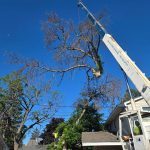
Arbor Tree Service provides professional tree removal in Danvers, MA for dead, damaged, hazardous, storm-damaged, and unwanted trees. Arbor has more than 30 years of tree industry experience, provides 24/7 emergency tree service, offers free written estimates, and states that its team is licensed, bonded, insured, and ISA-certified. Financing is also available for qualifying tree work.
30+ Years of Experience | 24/7 Emergency Service | Licensed, Bonded & Insured | ISA-Certified | Free Written Estimates | Financing Available
Tree removal in Danvers can be straightforward when a tree stands in an open area, or highly controlled when mature limbs extend over a house, driveway, neighboring property, utility connection, or established landscaping. The tree’s condition, access to the yard, available landing space, cleanup requirements, stump work, and local regulations all affect how the job should be planned.
Professional Tree Removal in Danvers, MA
A dead tree, major trunk split, root failure, severe decay, sudden lean, or extensive storm damage can make removal the better choice. A large tree does not automatically need to come down, though. When the trunk and roots remain suitable and the problem is limited to branches, clearance, or canopy structure, professional tree trimming or tree preservation may be a better use of the tree.
Arbor provides professional tree removal services for residential and commercial properties throughout Danvers and eastern Massachusetts. The site assessment looks at the tree’s size and condition, surrounding structures, access, overhead obstacles, and the space available to process wood after it comes down.
30+ years serving homeowners and commercial properties
Arbor Tree Service is family owned and operated and reports more than 30 years of tree industry experience. Its published services include tree removal, trimming, preservation, stump work, emergency response, land clearing, and crane-assisted removal.
Residential and commercial jobs often present different access problems. A backyard tree may be surrounded by fencing, lawn, patios, or a neighboring home. A commercial project may involve parking areas, pedestrian access, delivery routes, or scheduling around normal business activity. Those conditions should be identified before the work date rather than after equipment arrives.
Emergency Tree Removal: 24/7 Response in Danvers
A tree that has partially uprooted, split through the trunk, fallen onto a structure, blocked a driveway, or left a heavy limb suspended overhead should be treated as an urgent hazard. Arbor provides 24/7 emergency tree service for fallen trees, unstable trees, storm damage, and hazardous limbs.
The company’s site says regular inquiries are usually answered the same day. Emergency calls are available 24/7 and prioritized based on the hazard. A fixed arrival time should not be promised before dispatch because major storms can create several active calls at once.
Storm-damage removal in Danvers: what the response requires
There is no verified Danvers-specific Arbor Tree Service storm project published with enough detail to present as a local case study, so this page does not turn an unidentified customer review into one. Arbor’s documented emergency process gives homeowners a better idea of what happens when a damaged tree needs attention.
The first step is identifying what can move, fall, or shift. A partially uprooted root plate, cracked leader, broken limb under tension, or trunk resting on a building can behave differently once cutting begins. The work area is secured, the tree is assessed, and the removal method is selected before sections are released.
If the tree is touching a power line, do not approach it. Danvers Electric instructs residents never to attempt to remove trees or limbs from a utility line and to treat objects touching electrical conductors as energized. Electrical hazards should be reported to Danvers Electric before private tree work proceeds.
Tree Removal Cost in Danvers: Pricing, Timeline, and Financing
For planning purposes, 2026 Boston-area data places the average tree removal at about $812, with many projects between approximately $432 and $2,166. Open-access smaller trees can fall below that range, while very large trees, crane work, storm damage, and restricted access can cost considerably more.
| Tree Height | 2026 Boston-Area Planning Range |
|---|---|
| Up to 30 ft | $230–$700 |
| 30–60 ft | $700–$1,900 |
| 60–80 ft | $1,200–$2,300 |
| Over 80 ft | $1,500–$3,100+ |
These figures are regional 2026 market estimates, not fixed Arbor Tree Service prices. Arbor provides a free written estimate after evaluating the property.
Height is only one pricing factor. Trunk diameter, tree condition, proximity to buildings, equipment access, utility conflicts, rigging requirements, debris volume, crane setup, and stump work can change the scope. A 45-foot tree beside a house with no usable landing area can be a more involved project than a taller tree in open ground.
How long does a typical removal take?
Many straightforward single-tree removals can be completed within a few hours. A large tree beside a house or a tree that must be dismantled section by section may take most of the working day. Multi-tree projects can require additional time.
The estimate should cover the removal method and cleanup instead of giving a time promise based only on tree height.
Free written estimates and financing
Arbor provides a free written estimate after assessing the tree and work area. Financing is available. Ask about current financing options, eligibility, payment terms, and approval requirements when requesting the estimate, since financing programs can change.
Danvers Tree Removal Permits, Insurance, and Credentials
Do you need a permit to remove a private tree?
For an ordinary tree located entirely on private property and outside regulated resource areas, Danvers does not publish a separate general townwide tree-removal permit requirement. That changes when the tree is a public shade tree or when the work falls under Conservation Commission jurisdiction.
Public shade trees
The Danvers Forestry Division maintains approximately 40,000 town-owned shade trees along roadways, rights-of-way, parks, schools, public buildings, open space, Town Forest, and watershed property.
Massachusetts General Laws Chapter 87 places public shade trees under the Tree Warden’s control. A property owner cannot simply hire a private contractor to remove a street tree that falls within the public way. Written Tree Warden authorization applies, and removal of public shade trees generally involves the Chapter 87 hearing process unless a statutory exception applies.
If a tree near the road may be within the public right-of-way, contact the Danvers Forestry & Grounds Division before scheduling removal.
Trees near wetlands and protected resource areas
Danvers has stricter local wetland rules than simply looking at whether the trunk is standing in visible water. The Town’s Wetlands Bylaw regulates alteration within protected resource areas and within a 100-foot buffer zone around many wetlands, ponds, streams, banks, and similar areas.
Danvers regulations also establish a 35-foot No-Disturb Zone and a 50-foot No-Build Zone. Cutting trees, branches, roots, or other vegetation can qualify as an alteration. Some limited tree work can be handled through the Conservation Commission’s minor-project process, while other work may require a different filing.
If the tree is close to a wetland, stream, pond, riverfront area, or mapped buffer, contact the Danvers Conservation Commission before cutting.
Licensed, bonded, and insured
Arbor Tree Service publicly states that it is licensed, bonded, and insured and that its team is ISA-certified. Public insurance policy numbers and individual credential numbers are not displayed on the company website.
Before hiring any tree company, ask for current proof of insurance. The certificate should make it possible to verify the coverage in force for the work being proposed. For a job involving climbers, chainsaws, rigging, cranes, and heavy equipment, homeowners should ask specifically about liability insurance and workers’ compensation rather than relying on an advertisement that says only “insured.”
Credentials should also be read accurately. ISA Certified Arborist credentials, Massachusetts Certified Arborist credentials associated with the Massachusetts Arborists Association, and Tree Care Industry Association (TCIA) accreditation are separate qualifications. Arbor publicly states ISA certification; this page does not claim Massachusetts Arborists Association or TCIA credentials that have not been verified.
Crane-Assisted Removal and Protecting Your Landscape
A tree close to a house cannot always be dropped in one piece. Large branches may extend over the roof, while fencing, patios, septic areas, garden beds, pools, or neighboring properties can eliminate a usable landing zone.
Sectional dismantling gives the crew control over smaller pieces. For other sites, crane-assisted tree removal can lift secured sections away from the tree and move them to a processing area without dropping the wood into the yard.
Arbor’s crane process begins with site assessment, crane placement, reach, tree condition, soil conditions, surrounding structures, and the intended drop zone. Outriggers are placed on cribbing to distribute loads, and each section is secured before the cut is made.
How the landscape is protected during removal
Protecting a lawn or landscape starts before the cutting. The crew needs to identify where equipment can travel, where wood can be lowered or lifted, where branches will be processed, and which features need to stay outside the work zone.
Crane removal can reduce the amount of wood that reaches the lawn because sections are lifted to the processing area. Conventional removals can use controlled sectional dismantling instead of allowing large pieces to fall freely.
The correct method changes with the site. A crane is useful when its reach and setup solve a real access problem; it should not be treated as the automatic answer for every large tree.
Stump Grinding, Wood Chipping, and Complete Site Cleanup
Tree removal and stump removal are separate parts of the project unless the written estimate says otherwise. Arbor provides stump removal and grinding services when the remaining stump interferes with mowing, landscaping, construction, replanting, or use of the yard.
Regional 2026 Boston-area data places stump grinding around $180 to $620. Stump diameter, root flare, access, nearby pavement, utilities, and the requested depth can change the cost.
Arbor’s published cleanup process includes hauling debris and chipping branches after tree work. Logs, brush, and stump material can require different handling, so the written estimate should make clear what leaves the property and what, if anything, remains.
If you want firewood left, wood chips retained for mulch, the stump ground, or all material hauled away, settle those details during the estimate rather than after the removal is complete.
Danvers Trees, Local Conditions, and Places Homeowners Know
Danvers is in Essex County, about 20 miles northeast of Boston, with major travel routes including Route 1, Route 114, Route 128, and I-95. The Town reports that trees cover approximately 42% of Danvers, much of that canopy on private property.
Local forest areas give a useful picture of tree species found around town. Danvers’ Whipple Hill page specifically identifies white pine, red oak, beech, and red maple. Danvers Electric’s vegetation management documents also reference maples, oaks, ashes, cherries, birches, beeches, spruces, hemlocks, and pines as tree types encountered around utility rights-of-way.
Those species do not all behave the same during removal. Mature oaks can produce heavy limbs and trunk sections. Tall pines can create long vertical loads. Maples may develop broad crowns over homes and driveways. Beech and other mature hardwoods can involve substantial wood volume even when the canopy does not appear unusually tall from the street.
Endicott Park and Whipple Hill
Endicott Park covers 165 acres at 57 Forest Street, Danvers, with woodlands, marshes, orchards, trails, and historic farm buildings. From Route 128, the Town directs visitors to Route 62 West for roughly two miles, then left onto Forest Street and approximately 0.4 mile to the park. From Route 1 or I-95, use Route 62 East, turn right onto Forest Street, and continue about 0.4 mile.
Whipple Hill is the large forested open-space area within Endicott Park and is where the Town specifically documents white pine, red oak, beech, and red maple.
Rebecca Nurse Homestead
The Rebecca Nurse Homestead at 149 Pine Street preserves land and structures connected to Salem Village and the 1692 witchcraft trials. Its setting also reflects the older residential and wooded landscape found in parts of Danvers away from the major commercial corridors.
Danvers Town Forest
The Danvers Town Forest is at 54R Buxton Road. It covers more than 50 acres and includes roughly three miles of trails, wetlands, the Ipswich River edge, and certified vernal pools. Trees close to similar wetland conditions on private property deserve a regulation check before removal because Conservation jurisdiction can extend beyond the visible waterline.
Comparing Tree Removal Companies in Danvers
A lower quote is useful only if it covers the same work. When comparing tree removal companies in Danvers, read the scope rather than comparing one total against another.
- Experience: Ask how long the company has been performing tree removal and whether its experience includes large or hazardous trees.
- Insurance: Request current proof of coverage rather than relying on a logo or badge.
- Credentials: Ask exactly which arborist credential the evaluator or crew holds.
- Removal method: The quote should explain whether the job uses conventional removal, sectional dismantling, rigging, or crane-assisted removal.
- Emergency availability: Confirm whether after-hours storm response is available.
- Stump work: Find out whether grinding or removal is included or quoted separately.
- Cleanup: Confirm who handles brush, logs, wood chips, and final cleanup.
- Property protection: Ask how roofs, driveways, fences, lawns, gardens, and nearby structures will be handled during the work.
- Written estimate: Make sure price and scope are documented before work begins.
- Financing: If financing matters, review the current approval requirements and payment terms before authorizing the job.
Tree removal in Danvers and nearby North Shore communities
Arbor also maintains dedicated service pages for nearby communities, including tree removal in Beverly, MA, tree removal in Peabody, MA, tree removal in Middleton, MA, and tree removal in Topsfield, MA.
The surrounding service area also includes Boxford, Georgetown, Ipswich, and Marblehead.
Call for tree removal in Danvers, MA
If you have a dead tree, storm damage, a large tree close to your house, or another tree that needs professional evaluation, call Arbor Tree Service at (781) 245-2826. Request a free written estimate, ask about financing, or call for 24/7 emergency tree service when the problem cannot wait for normal scheduling.


